Published October 5, 2026
355 Days on Market: What Overpricing Really Costs

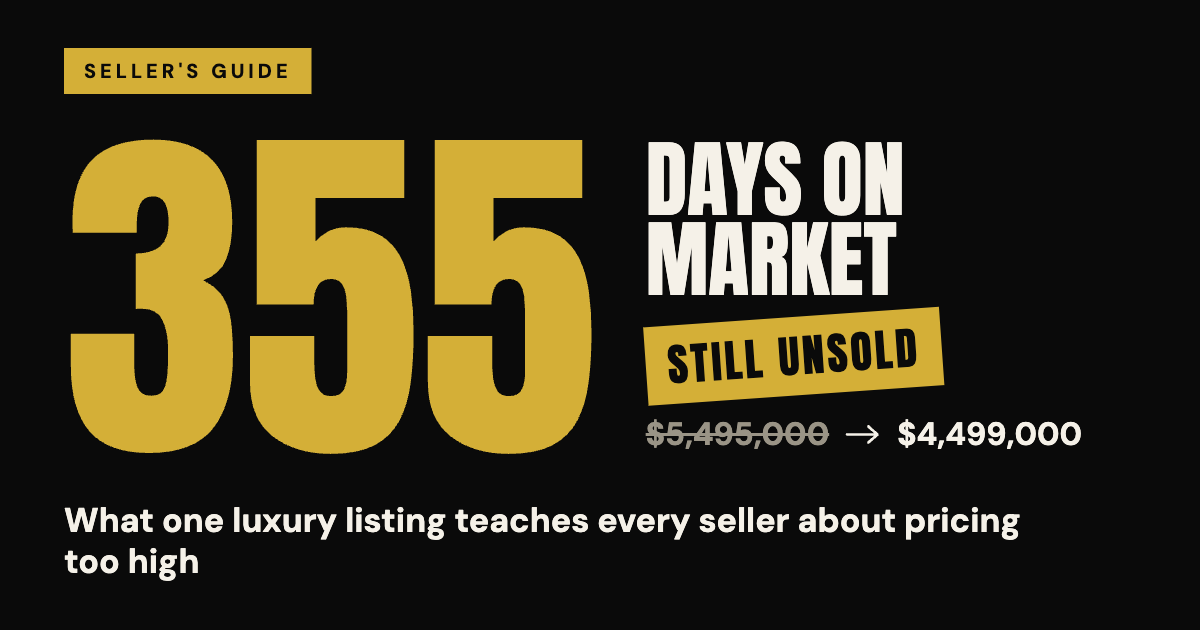
355 Days and a Million-Dollar Price Drop: What One Luxury Listing Teaches Every Seller About Pricing Too High
SEO title: 355 Days on Market: What Overpricing Really Costs
A luxury home in one neighborhood's latest market report has now been listed for 355 days. It started at $5,495,000 and now asks $4,499,000. That's nearly $1 million off the original price, and it still hasn't sold.
It's an extreme example, but the pattern behind it shows up at every price point. If your home isn't selling, the market is almost always telling you something.
The first two weeks matter most
Most buyers and agents watch new listings closely. A home gets its biggest burst of attention when it first hits the market, and that's when the price needs to be right.
Once a listing goes stale, buyers start asking what's wrong with it. They wonder why it hasn't sold, whether there's a hidden problem, and how much room there is to negotiate. A long time on market can hurt the price more than the condition of the home.
The "fresh start" trap
The same report shows another common move. One home was withdrawn after 154 days and relisted the same day. The new asking price was $1,985,000, down from $1,995,000. That's a $10,000 change on a nearly $2 million home, about half a percent.
Pulling a listing and relisting it can reset the "days on market" counter in some systems, but it doesn't change what buyers see. Buyers and agents who've watched a home sit for months usually recognize it right away. A cosmetic price change doesn't give them a reason to look again.
Small cuts don't move the market
Some sellers trim the price a little at a time, hoping to find the number that works. The problem is that small cuts rarely change buyer behavior. A price drop gets attention when it's large enough to change which buyers can afford the home or to shift how it compares to nearby listings.
Other homes in the same report took bigger steps. One came back to the market at $9,950,000 after starting at $11,450,000, a cut of about 13%. Another has come down from $11.5 million to $8,995,000, a drop of roughly 22%. These cuts are much more likely to bring buyers back than a symbolic trim.
How to tell your price is too high
Watch for these signs:
- Plenty of showings but no offers. Buyers like the home but not the price.
- Few showings at all. The price is filtering you out of searches before anyone sees the photos.
- Feedback about "value." If buyers keep saying they'd love it at a lower price, believe them.
- Nearby homes selling while yours sits. Compare against homes that actually closed, not just ones listed.
When to cut
If you get little activity in the first two to three weeks, that's usually the time to act. Waiting makes the home look stale and costs you carrying expenses like mortgage, taxes, and insurance. Those costs can easily exceed what you'd lose by pricing correctly from the start.
Aim for a cut big enough to put your home in a new price bracket in search results. A well-priced home gets multiple buyers competing. An overpriced one gets none.
The bottom line
The 355-day listing didn't fail because the home was bad. It failed because the price and the market never matched. If you're thinking of selling, the best move is to price with real comparable sales from the start. If you're already on the market and things have gone quiet, the numbers above are a good reason to reassess now.
Thinking of selling and not sure where to price? Reach out for a free pricing review based on recent sales in your area.